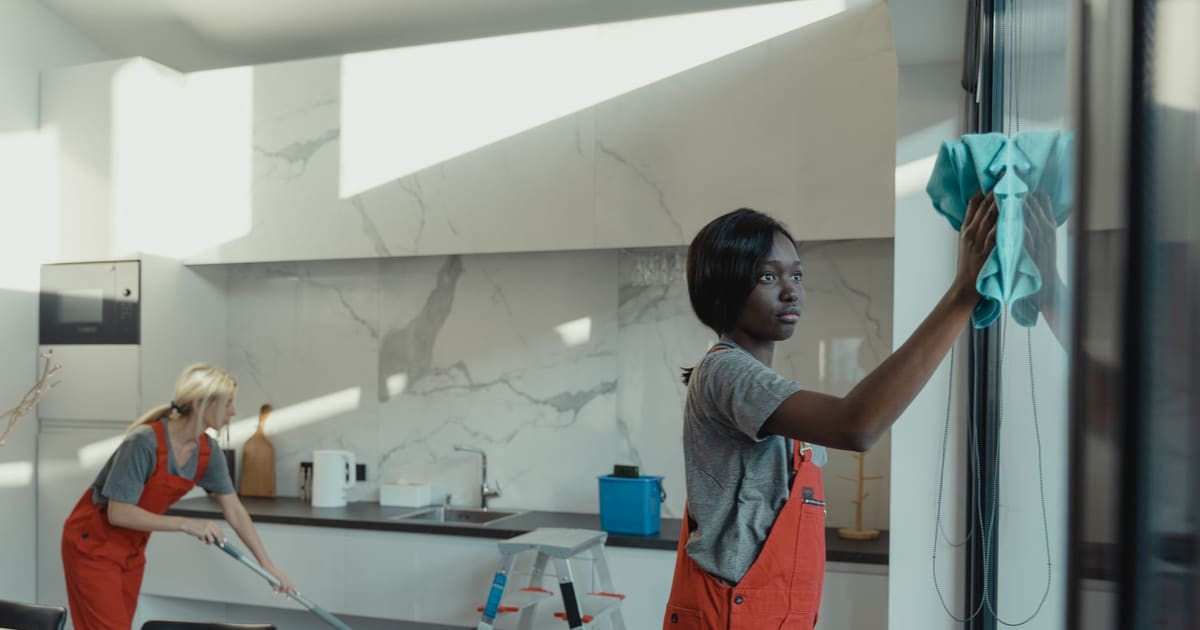
Apartment cleaning in the US typically costs $75 to $200 for a standard visit, depending on unit size, local labor rates, and the condition of the space. A studio or one-bedroom generally runs $75 to $130, a two-bedroom $110 to $180, and a three-bedroom apartment or condo $150 to $250. One-time and move-out cleans run higher. Prices vary widely by market.
What You Will Typically Pay by Unit Size
The most reliable way to understand apartment cleaning costs is to start with unit size, then adjust from there. According to HomeAdvisor and Angi cost surveys, which aggregate self-reported job data from homeowners and renters across the US, the following ranges reflect standard (non-deep) cleaning visits by a professional service.
| Unit Size | Typical Cost Range | Notes |
|---|---|---|
| Studio (under 500 sq ft) | $75 -- $120 | Minimum-visit fees often apply; see note below |
| 1-bedroom apartment | $90 -- $150 | Most common residential booking |
| 2-bedroom apartment or condo | $110 -- $180 | Cost rises with additional bathroom |
| 3-bedroom apartment or condo | $150 -- $250 | Varies significantly by total square footage |
| 3+ bedroom large condo | $200 -- $300+ | Comparable to mid-size house pricing |
These are national ranges drawn from HomeAdvisor's 2024 cost data and should be treated as starting points. In high-cost metros such as New York City, San Francisco, or Boston, rates routinely run 30 to 50 percent above these figures. In smaller cities and rural markets, they can run 20 to 30 percent below.
Why Apartments Can Cost More Per Square Foot Than Houses
On an absolute basis, cleaning a 700-square-foot apartment costs less than cleaning a 2,400-square-foot house. That part is straightforward. But the per-square-foot math can flip in the apartment's direction, and it is worth understanding why before you compare quotes.
Most cleaning services set a minimum visit fee -- commonly $80 to $100 or more -- regardless of how small the space is. This minimum exists because the cleaner's time driving to and from the job, parking, and setting up represents a fixed cost to the business. A studio apartment that would otherwise generate $60 worth of cleaning labor still requires that minimum to be worth booking. The practical result is that small apartment owners often pay a higher effective rate per square foot than the owner of a larger home who spreads that minimum across more square footage.
This is not a surprise fee if you ask about it upfront. When you request a quote, ask whether the service has a minimum visit charge and what it is. That one question will help you evaluate whether flat-rate pricing or hourly vs flat-rate pricing makes more sense for your unit.
Minimum-visit fees and small apartments
If your apartment is under 500 square feet, the minimum-visit fee is likely to be the dominant cost factor in your quote -- not the square footage itself. Ask each service what their minimum is before you compare prices. A service with a $100 minimum may be more expensive for your studio than a service with a $90 flat rate, even if the first service advertises a lower hourly rate.
How Building Access and Logistics Affect Your Quote
Cleaning a freestanding house and cleaning an apartment in a six-story building are logistically different, and some of those differences show up in the price.
Parking. In dense urban markets, street parking can be difficult or metered. A cleaner who has to walk three blocks with a supply caddy, or pay for parking out of pocket, is absorbing a real cost. Some services pass this through as a surcharge; others build it into urban-market base rates. If you live in a city with limited parking near your building, mention it when you get a quote and ask how the service handles it.
Elevator access vs. stairs. Buildings with freight elevator access are easier to service than walk-up buildings. Hauling a vacuum, mop, and supply bag up four flights of stairs adds time and physical effort to every visit. Services that work frequently in walk-up buildings often price those jobs slightly higher, or they may apply a per-floor surcharge after the first or second floor. Ask.
Building entry procedures. If your building requires the cleaner to check in with a doorman, receive a key fob from the front desk, or wait for a buzzer, that adds time to the start of each visit. Most services account for a few minutes of entry overhead, but unusually slow or complicated building access can affect scheduling and occasionally pricing.
Unit condition. A standard recurring clean assumes the apartment has been maintained between visits -- dishes are cleared, surfaces are generally picked up, clutter is managed. If you are booking a first-time clean on a space that has not been professionally cleaned in a long time, expect the quote to reflect that. Heavily soiled units, kitchens with significant grease buildup, or bathrooms with mineral scale require more time and sometimes specialized products.
Standard Clean vs. Deep Clean for an Apartment
The term "standard clean" refers to routine maintenance cleaning -- wiping surfaces, vacuuming and mopping floors, cleaning toilets and sinks, and tidying the kitchen. It assumes the apartment is already in reasonable shape and is meant to maintain that baseline between visits.
A deep clean goes further. It includes cleaning inside appliances, scrubbing grout, descaling faucets and showerheads, cleaning interior cabinet faces and drawer tracks, and addressing buildup in areas that routine cleaning does not reach. Deep cleans take significantly longer and cost proportionally more -- typically 1.5 to 2 times the price of a standard clean for the same unit, according to industry pricing data published by HomeAdvisor.
For an apartment, you are most likely to need a deep clean in two situations: when you are starting recurring service for the first time, and when you are preparing to move out. Many services require a deep clean as the initial visit before they will take you on as a recurring client. This makes sense from their perspective -- maintaining a space is easier than rehabilitating one, and they need a reliable baseline to promise consistent results on subsequent visits.
If you are a landlord or property manager looking to turn an apartment between tenants, a standard clean is rarely sufficient. Move-out situations typically require a deep clean that meets lease-agreement standards.
Move-Out Apartment Cleaning
Move-out cleaning is its own category. Landlords and property managers often require apartments to be returned in a professionally cleaned condition, and the cleaning standard is more demanding than what a standard recurring service delivers. Cleaners are expected to address areas that are rarely touched during routine visits: inside the oven, inside the refrigerator, behind the toilet, the interior of closets, and window tracks.
Move-out cleaning for an apartment typically costs $150 to $300 for a one-bedroom unit and $250 to $450 or more for a three-bedroom, according to HomeAdvisor 2024 pricing data. The wide range reflects variation in unit size, condition, and whether the service includes cleaning inside appliances. For a full breakdown of what move-out cleaning covers and what it costs by unit size, see our guide to move-out cleaning cost.
Confirm the scope before you book a move-out clean
"Move-out clean" means different things to different services. Ask for a written checklist that specifies whether appliance interiors, window tracks, interior cabinet surfaces, and walls are included. If the checklist does not match your lease's cleaning requirements, negotiate before the appointment -- not after the cleaner has left.
How Recurring Service Lowers Your Per-Visit Cost
One of the most practical cost levers available to apartment renters who use professional cleaning regularly is the recurring service discount. Most cleaning companies charge less per visit when you commit to a regular schedule -- typically weekly, biweekly, or monthly.
According to HomeAdvisor, recurring clients typically pay 10 to 20 percent less per visit than customers booking one-time cleans. A one-time standard clean for a two-bedroom apartment that costs $160 might run $130 to $145 per visit on a biweekly recurring plan. Over the course of a year, that difference adds up to several hundred dollars.
Recurring service rates are negotiable at the start
The best time to ask about recurring service pricing is before you book your first visit, not after you have already paid one-time rates for several months. Tell the service upfront that you are interested in a recurring plan and ask what that rate looks like. Many services will also reduce the one-time rate for the initial deep-clean if you commit to recurring visits at the same time.
Biweekly service is the most common schedule for apartment dwellers who want professional help without a high monthly spend. Weekly service suits households with children, pets, or frequent visitors. Monthly service keeps costs low but requires more upkeep between visits.
If you are weighing the economics, our guide to recurring cleaning service cost covers how to evaluate which frequency makes financial sense for your space and usage.
Getting an Accurate Quote for Your Apartment
A vague quote is not useful. Before you accept any estimate, make sure the service has accounted for the following:
Square footage and layout. Provide your apartment's actual square footage, not a rounded approximation. A 950-square-foot one-bedroom with an open kitchen is different from a 700-square-foot one-bedroom with a separate dining room and two full bathrooms.
Number of bathrooms. Bathrooms are the most time-intensive rooms in any cleaning visit. A one-bedroom apartment with two bathrooms costs more to clean than a two-bedroom with one. Always specify the bathroom count in your initial inquiry.
Building access specifics. As covered above, mention parking constraints, walk-up stairs, and any building entry procedures that add time to the visit.
Service type. Specify whether you want a standard clean, a deep clean, or a move-out clean. Do not assume the service will default to the right option.
Products and equipment. Confirm whether the service brings its own cleaning products and equipment, or whether you are expected to supply them. If you have surface-specific requirements -- fragrance-free products, non-toxic cleaners, specific solutions for stone countertops -- communicate those before booking.
For a broader comparison of how apartment cleaning costs compare to single-family house cleaning, see our overview of house cleaning cost.
What to Look for in the Service Itself
Price is one input. The reliability and trustworthiness of the service you hire matters just as much, especially when you are giving someone access to your home on a recurring basis.
Look for services that are bonded and insured. Bonding protects you against theft claims; liability insurance covers accidental damage. Ask for proof of both before your first visit, not just a verbal assurance that coverage exists.
Ask whether the company performs background checks on its cleaners. Most reputable services do, and they will tell you so directly. If a company is evasive on this point, treat that as a signal.
Confirm that the service has a satisfaction guarantee or re-clean policy. A well-run company will return to fix missed areas at no charge within a specified time window, typically 24 to 48 hours. Find out whether this applies to the initial deep clean as well as recurring visits.
Finally, if you are having a new service into your apartment for the first time, secure valuables, prescription medications, and sensitive documents before the visit. This is standard good practice when any new person enters your home, and it removes ambiguity if anything comes up afterward.
Understanding whether to use an independent cleaner or a cleaning agency also affects both price and the protections available to you -- our guide to hourly vs flat-rate cleaning covers how the pricing structure reflects some of those trade-offs.
What to remember about apartment cleaning costs
Apartment cleaning costs less in absolute terms than cleaning a larger home, but minimum-visit fees can make small units more expensive per square foot. Get quotes that specify service type, bathroom count, and building access. Recurring clients typically pay 10 to 20 percent less per visit than one-time rates. Confirm that any service you hire is bonded, insured, and uses background-checked cleaners.
Frequently asked questions
How much does it cost to clean a studio apartment?
A standard cleaning for a studio apartment typically runs $75 to $120, though prices vary by city and service type. Studios often have a minimum-visit fee that makes the per-square-foot rate higher than larger units. Deep cleans and move-out cleans cost more, often $130 to $200 for a studio.
Why does apartment cleaning sometimes cost more per square foot than house cleaning?
Most cleaning services set a minimum visit fee, often $80 to $100 or more, regardless of unit size. A small apartment may fall below that minimum's natural square-footage equivalent, so the per-square-foot effective rate runs higher than a larger home that spreads the minimum across more area.
Does living on an upper floor or requiring elevator access affect the cleaning price?
It can. Some services charge a small surcharge for buildings without elevator access or for locations that make hauling supplies difficult. Street parking limitations that force the cleaner to park several blocks away may also add time to the visit. Ask your provider directly when you get a quote.
How often should I have my apartment professionally cleaned?
Most apartment dwellers who use recurring service schedule cleanings every two or four weeks. Weekly service is available for high-traffic homes or households with young children or pets. Recurring clients typically pay 10 to 20 percent less per visit than one-time booking rates, according to HomeAdvisor data.
Is a deep clean necessary before starting recurring service?
Many cleaning services require or strongly recommend an initial deep clean before the first recurring visit. This brings the apartment up to a baseline they can maintain on each subsequent visit. Expect to pay 1.5 to 2 times the standard recurring rate for that first appointment.